AI-based quality optimization for high-tech production lines
The automotive supplier Valeo has started an application-oriented research and development project with the Fraunhofer AI spin-off plus10 and the AI institute AImotion Bavaria of the Ingolstadt University of Technology. The aim of the project is to increase the efficiency of highly automated production lines with the help of novel machine learning algorithms.
Felix Georg Müller
January 27, 2022
The automotive supplier Valeo has started an application-oriented research and development project with the Fraunhofer AI spin-off plus10 and the AI institute AImotion Bavaria of the Ingolstadt University of Technology. The goal of the PALIM (Performance-Accelerated Learning for Intelligent Manufacturing) project is to increase the efficiency of highly automated production lines with the help of novel machine learning algorithms. The PALIM research project is funded by the Free State of Bavaria as part of the High-Tech Agenda via the Bavarian Joint Research Program (BayVFP) for three years.
At the kick-off meeting for the PALIM project at Valeo's Wemding site, the guidelines for the research project were set. The aim of the project is to use the example of a highly automated production and assembly line to systematically further research the suitability of modern deep learning methods for time series processing and to evaluate them in an application-oriented manner. The state-of-the-art production line, in which optics and electronics are adaptively assembled, connected and tested, is a predestined use case for this.
Autonomous driving, automation and artificial intelligence in Germany: promoting expertise
The production line at the Wemding site produces integrated sensors and camera systems for driver assistance through to autonomous driving. It is a market with increasing demand. From a production perspective, the challenge is to manufacture smart sensors in high volumes. This makes it all the more important to drive the use of novel optimization tools in German production facilities that are continuously learning.
"The automation industry is still in the early stages of discovering and making extensive use of deep learning approaches in processes. Such methods can offer potentially higher accuracy and generalization than conventional machine learning approaches and represent a real production advantage," explains Felix Georg Müller, Managing Director at plus10.
The project partners: plus10, Valeo and TH Ingolstadt
In order to successfully implement this project, all three parties to the alliance bring different competencies to the table:
The experts for self-learning production optimization from plus10 provide PALIM with the know-how and many years of practical experience in high-frequency machine data acquisition, fusion and handling as the basis for all R&D work. On the research and development side, plus10 will contribute expertise and preliminary work in the area of behavioral modeling of manufacturing processes and modeling approaches to explain phenomena that occur using classical and deep learning approaches.
With the research professorship for AI-based optimization in automotive production at the Almotion Bavaria Institute, Ingolstadt University of Applied Sciences is responsible for the implementation, documentation and experimental evaluation of various machine learning processes and methods.
Through its site in Wemding, Valeo is contributing its knowledge of highly automated production for proprietary cutting-edge technologies. Through Valeo.ai, the first global center for artificial intelligence and deep learning in the automotive industry, the project can draw on a research track record led by 200 AI experts* with close ties to the scientific and academic community.
The PALIM research project is funded by the Free State of Bavaria with an amount of € 1.3 million via the Bavarian Joint Research Program (BayVFP) over 3 years until August 2024. It is thus part of the High-Tech Agenda Bavaria and the development of Augsburg and Ingolstadt as AI future locations in Bavaria. The project is supervised by the project management organization VDI/VDE Innovation + Technik GmbH.
At the kick-off of the PALIM research project at the Valeo site in Wemding, the project leaders Lukas Lodes, Felix Georg Müller, Prof. Dr. Alexander Schiendorfer, Lena Kunz, Christian Pfefferer, Maximilian Schwab, Steffen Klarmann (from left to right) met. Image source: Valeo GmbH.
At Fakuma 2026, ARBURG will introduce the Hopper AI tool from plus10, which is integrated into the Gestica control system: The self-learning software analyzes quality-relevant process data in real time and automatically suggests appropriate parameter adjustments to the machine operator to prevent scrap from occurring in the first place. On display at ARBURG in Hall A3, Booth A3-3101.
Injection molding machines provide more data than ever before, yet scrap remains the most costly unsolved problem for many processors. Based on a survey of over 100 plastics processors, plus10 CEO Felix Georg Müller and Dr. Stefan Kruppa (kundu X) show where the real problem lies: not so much in a lack of data as in a lack of the ability to take action. Their solution: Process data becomes process intelligence when the system offers concrete recommendations for action instead of just providing yet another dashboard.
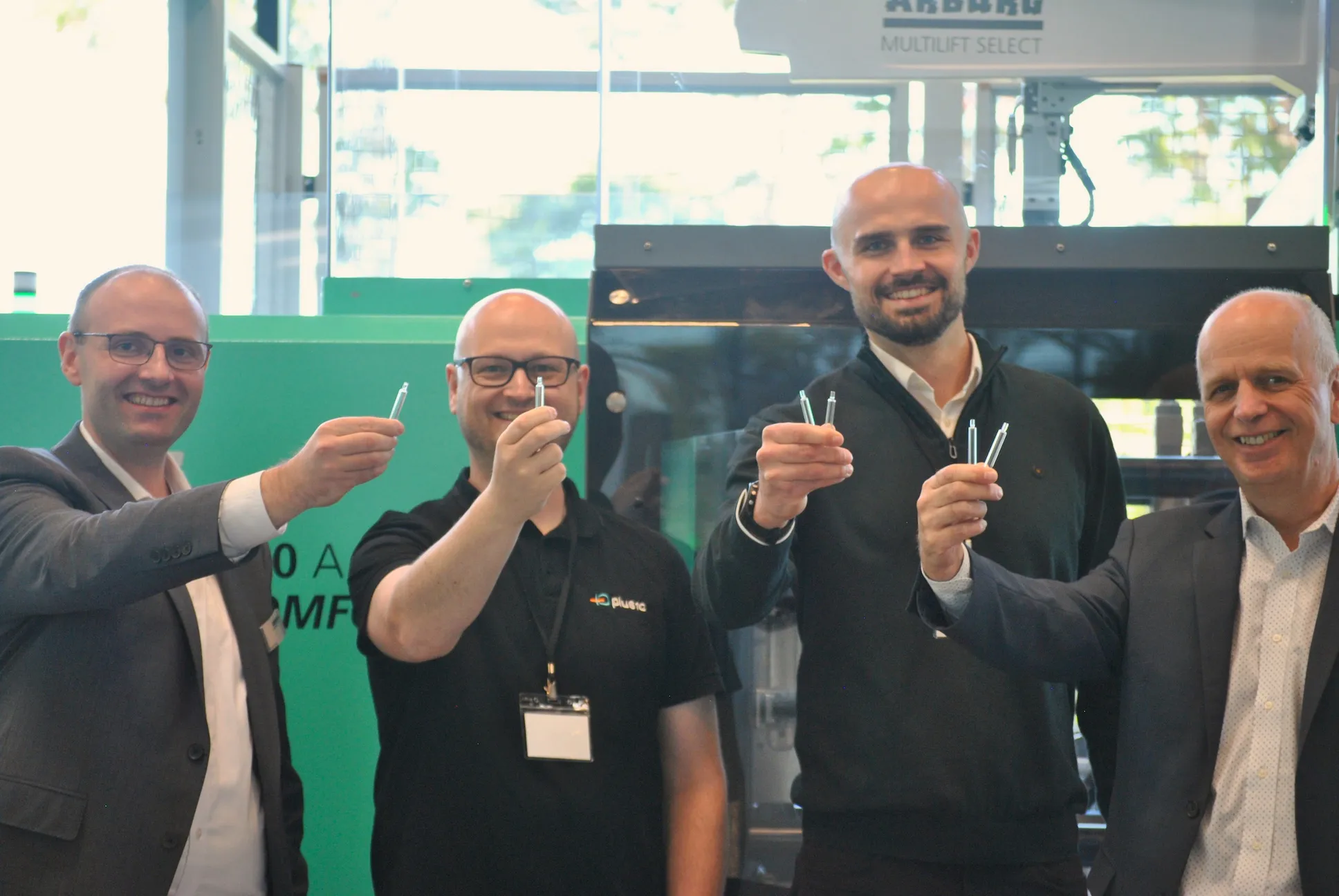
At TechXellence 2026 in the U.S., plus10, together with ARBURG, demonstrated the Hopper AI solution—fully integrated into GESTICA—live on an injection molding machine. The software detects the risk of scrap in real time and automatically recommends appropriate process parameters to reduce scrap and optimize production.


.webp)



.jpg)