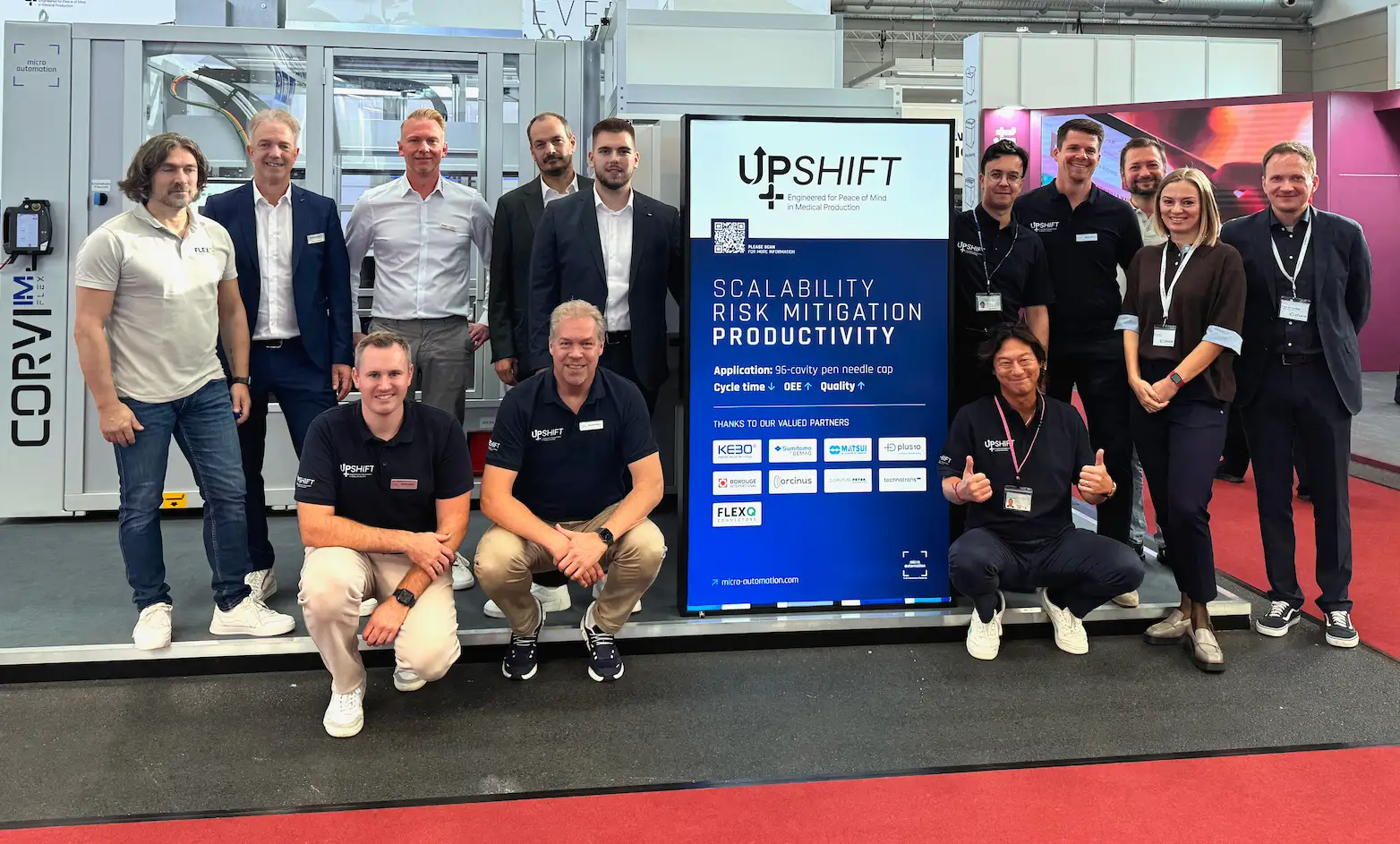
At Fakuma 2026, the network unveiled a joint demonstrator for the first time—the self-learning software ensured process stability in real time.
Augsburg, Oct. 27, 2026 – Under the name UPSHIFT, ten companies have joined forces to form a network that combines their technologies into a complete, cleanroom-compatible solution for medical device manufacturing. At Fakuma 2026, the network presented a joint demonstrator for the first time that manufactures an inner needle hub for insulin pens. plus10 serves as the intelligence layer: The self-learning Hopper software uses process data from the entire line to generate specific optimization recommendations for the machine in real time.
Each partner contributes a clearly defined role along the value chain—from materials to machinery, tooling, temperature control, and automation, all the way to data-driven optimization. The network includes Borouge, Matsui, Sumitomo (SHI) Demag, KEBO, technotrans, orcinus, FLEXQ Connectors, Petek, MA micro automation, and plus10.
Specifically, plus10—a Fraunhofer AI spin-off—offers Hopper, an AI application for injection molding optimization. The software continuously analyzes machine, process, and material data and uses this information to generate cavity-specific quality metrics; if a negative prediction is made, it immediately provides real-time parameter recommendations. It automatically adapts to material and batch variations while consistently remaining within validated, GMP-compliant process windows. The result: less scrap, shorter cycle times, and expert-level process knowledge on every shift.
“Continuously learning AI has long been viewed with caution in regulated manufacturing—and rightly so, as long as there is no suitable control strategy,” says Felix Georg Müller, CEO and co-founder of plus10. “In our peer-reviewed case study published in the ISPE’s Pharmaceutical Engineering magazine (August 2026), we—together with AI qualification experts from Bayer, Syntegon, Deloitte, and others—demonstrated for the first time that a continuously learning system can be qualified and operated even in a GMP-regulated, high-risk application, without any design freeze. With UPSHIFT, we’re taking this from theory to real-world production: Hopper uses live data from each station to generate cavity-specific recommendations in real time—proving that adaptive AI and GMP compliance are not mutually exclusive.”
Through this integrated approach, UPSHIFT addresses the industry’s biggest challenges—from validation efforts and regulatory pressure to the secure scale-up from pilot to mass production in 24/7 operations. Instead of having to coordinate numerous individual suppliers, manufacturers receive a coordinated, end-to-end solution with clearly defined responsibilities—and thus significantly greater planning certainty during production ramp-up.
The UPSHIFT network’s next joint appearance is already planned: MD&M West in Anaheim, California, from February 9 to 11, 2027. The next European dates will be announced shortly.