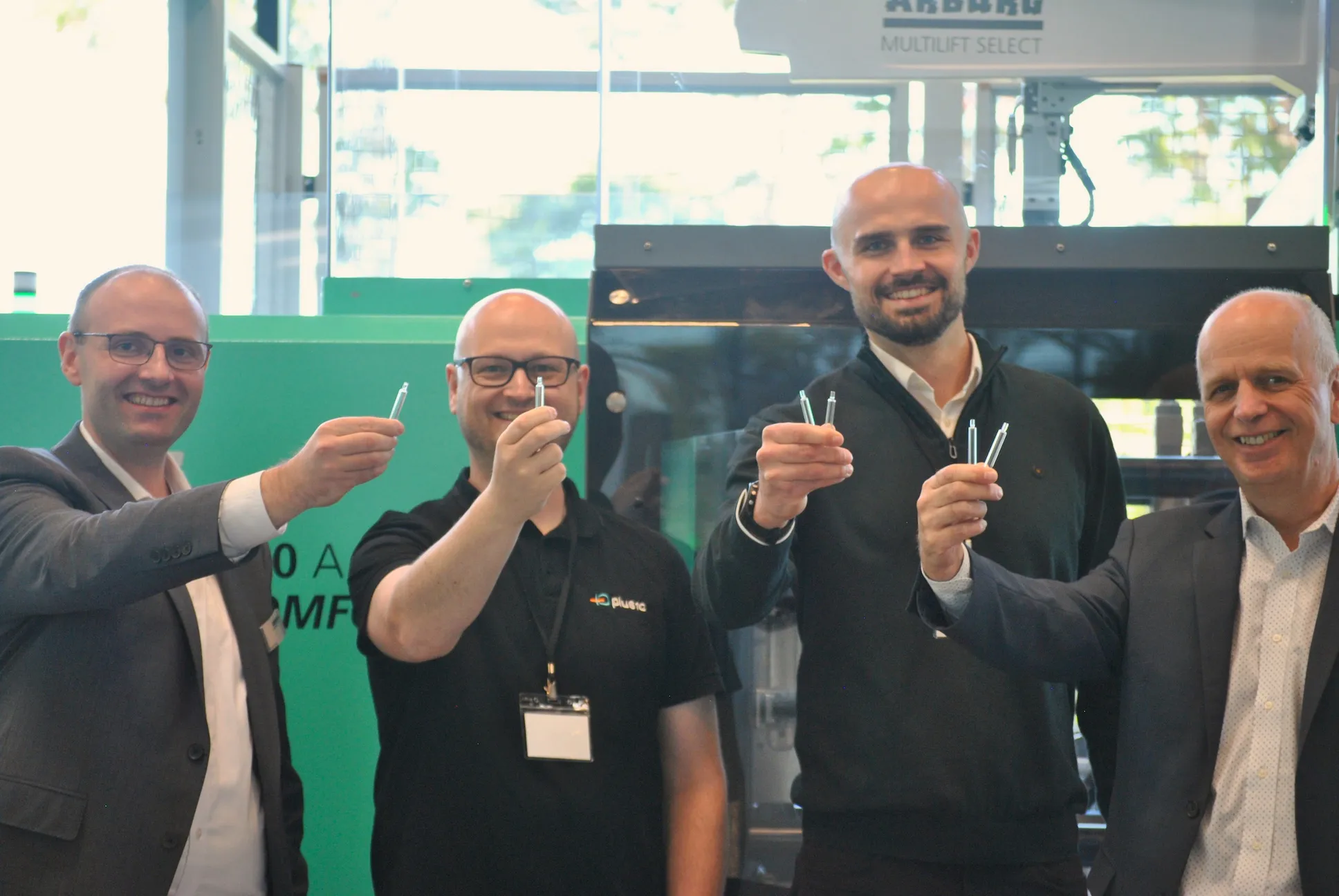
Rocky Hill, CT / Augsburg – plus10 participated as a partner and co-exhibitor at TechXellence 2026, ARBURG Inc.’s in-house trade show, held on September 24, 2026, at the Technology Center in Rocky Hill, Connecticut (USA). The event focused on AI, automation, and data-driven decision-making in manufacturing.
At the event, plus10 demonstrated the Parameter Recommender Hopper live on a fully electric ARBURG injection molding machine equipped with a 4-cavity COC mold from ZAHORANSKY.
Fully integrated: Hopper in the ARBURG GESTICA control system
Hopper learns from machine, raw material, and process data and recommends the appropriate settings for each situation—including for plasticizing, injection molding, and holding pressure—covering more than 60 parameters, always within the validated process windows. Instead of manual trial and error, Hopper provides specific adjustments that reduce scrap by up to 20% and keep cycle times low.
“The plus10 Hopper software, which is fully integrated into our Gestica, was a highlight of TechXellence,” says Martin Baumann, President & CEO of ARBURG Inc. “This allows us to meet the needs of our customers in the U.S.: Hopper continuously learns and can improve the process over time—which helps ensure the consistent production of high-quality parts.”
The features showcased at the event included:
- Predicting Scrap Risk: Hopper's AI model continuously calculates the probability of scrap in real time.
- Context-Based Parameter Suggestions: The system recommends adjustments to process parameters based on machine data and contextual information, such as the properties of the raw material.
- Automatic Documentation: Whenever a parameter is changed, Hopper automatically generates the corresponding documentation—ensuring traceability in regulated environments.
- Adaptive response to batch-to-batch variations in raw materials: such as differences in drying, temperature, viscosity changes, or varying batches. Also works with challenging materials such as COC/COP, PEEK, PBT, PPS, and PA.
- Flexible application of parameters: Hopper writes the recommended parameter adjustments directly into the machine control system. Depending on the customer’s preference, this is done either in “human-in-the-loop” mode—in which an operator reviews and confirms each change before it takes effect—or in “human-on-the-loop” mode—in which Hopper automatically implements validated adjustments while the operator continues to monitor the process.
- Fully integrated into ARBURG GESTICA: The hopper exchanges data bidirectionally with ARBURG GESTICA.
Hopper will be back in the U.S. on November 12, 2026: plus10 will once again be exhibiting at the ARBURG Technology Day West Coast USA in Irvine, California.

.jpg)